Who’s leading the way in housing — and why safety has to be at the front of the agenda
Tuesday 28th October, 2025
Photo courtesy of the South East Consortium, SEC2025: Who's Leading the Way?
This year’s South East Consortium Conference on Wednesday 15th October had a timely theme, “Who’s Leading the Way?”, which felt less like a debate about credit and more like a challenge to the housing sector: who will step up and make safety the non-negotiable foundation of good housing? Whether you were in the room or following updates on LinkedIn, the message was clear. In housing, being a leader isn’t just about building or managing properties; it’s about ensuring the people living in them are genuinely safe.
Here’s why that matters.
Housing is where risk and duty meet.
Most fire-related deaths occur in people’s homes. According to fire and rescue incident statistics for the year ending December 2024, there were 254 fire-related fatalities in England, with 199 of those deaths happening in dwelling fires — approximately 78% of fire deaths occurring where people live.
High-rise and multi-occupancy buildings remain a key focus. In the year ending December 2024, fire and rescue services responded to 697 fires in purpose-built high-rise flats or maisonettes, and over the past five years, they attended 3,679 fires.
High-rise buildings have been linked to multiple fatal fires and remain a priority for targeted protections and person-centred planning. These figures are not just statistics — they represent real people, families, and vulnerabilities that the sector must address.
Photo courtesy of the South East Consortium, SEC2025: Who's Leading the Way?
Vulnerability is diverse — and the law is changing to reflect that.
A critical outcome of discussions at events like the SEC Conference is recognition that residents are not a single group. A one-size-fits-all approach to fire safety strategy is not fit for purpose. Some residents need additional help evacuating safely for many different reasons.
The law is finally catching up.
The Fire Safety (Residential Evacuation Plans) (England) Regulations 2025 will come into force on 6 April 2026. From that date, Responsible Persons will be required to identify residents who may need support to evacuate and to develop Residential Personal Emergency Evacuation Plans (Residential PEEPs) for specified residential buildings, such as those over 18m. This marks a significant step towards person-centred fire safety in the residential sector.
The new regulations demand practical implementation: assessments, engagement with residents, regular reviews, data-sharing (with consent) with fire and rescue services where necessary, and feasible plans linked to building evacuation procedures and routine management.
Photo courtesy of the South East Consortium, SEC2025: Who's Leading the Way?
So, who should "lead the way"?
Leadership is shared — but some roles are uniquely positioned to act now:
- Responsible Persons / Landlords and Building Managers — they have the statutory duty to identify and plan for residents needing help and ensure those plans are workable. The regulations make this explicit from 6 April 2026.
- Fire and Rescue Services — they must be involved in planning and information sharing, where consent is given.
- Housing Associations and Support Providers — they know residents best and can turn plans into practical support.
- Consultants, Contractors, and Supply Chain Partners — design and maintenance choices (from door hardware to escape routes and alarm and detection strategies) significantly influence how evacuation functions in practice.
- Residents and Tenant Groups — active engagement and co-production ensure plans remain realistic, usable, and trusted.
Events like the SEC Conference are vital because they provide a platform for these responsible groups to exchange ideas, share innovations, and agree on practical measures.
Watch the video above for insight into our day at the SEC Conference 2025.
What TEAM Safety Services is doing — and how we can help
At TEAM Safety Services, we’ve been working with housing providers for over 15 years to translate regulation into practical, auditable, resident-centred practice.
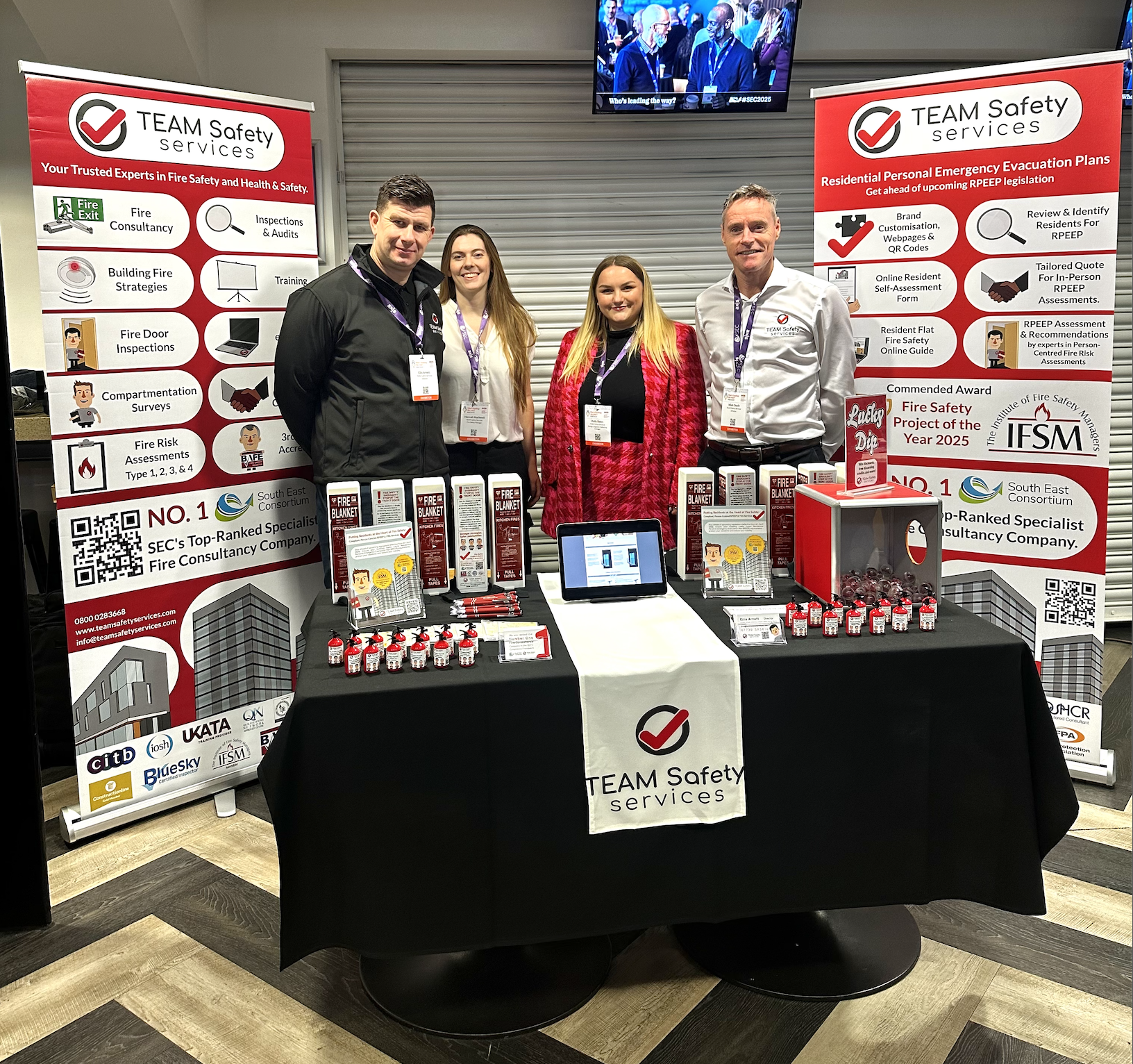
A TEAM photo of Ellis, Hannah, Polly and Mick on their stand at the SEC Conference 2025.
We have launched a comprehensive RPEEP service that helps to ensure residents' safety and housing providers' compliance in four simple steps:
- Identify Who Needs an RPEEP & Residents with Evacuation Needs: Start with our free Resident Assessment Form to identify residents requiring a RPEEP. Residents will also receive access to our Flat Fire Safety Guide to help them recognise hazards and stay safer at home.
- Review & Tailored Quote: Our fire safety experts will review responses, identify at-risk residents, propose a tailored quote, arrange a person-centred fire risk assessment, and supply a compliant RPEEP as required.
- Residential Personal Evacuation Emergency Plans: Working together with the resident, our experienced and competent Assessors create a bespoke evacuation plan aligned with the building’s fire safety strategy.
- Record & Share: The RPEEP is formally communicated to the housing provider, the resident, and, where appropriate, the local fire and rescue service — so everyone understands how to respond in an emergency.
We are proud to have received a Commended Award at the prestigious Institute of Fire Safety Managers (IFSM) Awards 2025, in the category Fire Safety Project of the Year for our Residential Personal Emergency Evacuation Plan services. This RPEEP project emphasises prioritising people over policies in fire safety.
We have also launched a Building Safety Act Awareness eLearning course tailored for housing managers, Responsible Persons, in-house safety teams and contractors.
Our eLearning course covers:
- The purpose of the Building Safety Act 2022.
- How to identify higher-risk buildings and their scope.
- How to recognise the three Gateways in the building lifecycle.
- The role and powers of the Building Safety Regulator.
- How to explain the Golden Thread and who maintains it.
- The responsibilities of dutyholders and Accountable Persons.
- How to apply competence requirements in practice.
- How to describe resident engagement, registration, and certification duties.
- Key reforms to fire safety and limitation periods.
If you want to ensure your teams are trained, confident, and ready to lead the way, this course is designed as a practical first step — not just a tick-box exercise. It’s focused, accessible, engaging, and intended to be completed in only 20-30 minutes, so staff can apply what they have learnt on the same day.
Illustration by TEAM Safety Services Ltd.
Conferences like the South East Consortium’s remind us that the housing sector is evolving — for the better — but change is only meaningful if it safeguards people.
With hundreds of dwelling fatalities each year and thousands of incidents affecting residents at home, this is a safety-first moment for everyone involved in housing. The new Residential PEEPs regulations (coming into force on 6 April 2026) make person-centred planning a legal requirement — and a moral one.
Those who lead will be the organisations that regard safety as a core element of quality housing: prevention, preparedness, and people-centred practice—all working in harmony.